
A Black Masterbatch Supplier for Film That Must Look Consistently Black

A bag of black pellets does not tell a film converter how black the finished film will look. The relevant comparison is the film made at the intended thickness, with its actual resin and agreed viewing conditions. MIRACLE’s black masterbatch family offers a manufacturer-backed starting point for PE/PP coloring, with a published series range of 18%–50% carbon black. A useful black masterbatch supplier connects that range with the product you make instead of treating concentration as a finished-film approval.
For packaging buyers, the first questions are whether the film must hide what is behind it, how it will be seen in use and which processing conditions define the trial. MIRACLE combines production with in-house development and material evaluation, so the discussion can include both the desired appearance and the way the concentrate is introduced into the resin.
A black masterbatch supplier should distinguish black appearance from hiding
A film can appear dark when folded and less opaque when opened over a light background. That does not mean the pellets have changed. It means the buyer is evaluating a different visual arrangement. Before selecting a concentrate, establish which arrangement represents the finished product and how the reference sample will be compared with the candidate.
MIRACLE’s black PE/PP masterbatch range is described around black appearance, dispersion and film or molded-product applications. For a film enquiry, retain the actual film form and thickness context rather than accepting a thicker sample as an unconditional representation of the product that will be sold.
Consider a converter making a black bag intended to conceal its contents. The commercial requirement is not simply that the bag has a black color name; its appearance through a single wall may matter to the customer. The supplier needs that information when the proposed material and evaluation route are discussed. This is an illustrative product decision, not a reported MIRACLE customer result.
Black film viewed against a light background needs an agreed reference
If the buyer judges the film over a light background, use a comparable arrangement for the retained reference and the trial sample. Changing the background during the review can make the comparison less useful. The product brief should explain whether the intention is a specific black impression, a hiding objective or both.
The agreed evaluation should also identify whether a single layer, a folded sample or the finished bag is being reviewed. These forms can answer different questions about the same material. A supplier can work more effectively with that distinction than with photographs taken under unrelated conditions and labeled only as “not black enough.”
Film thickness changes the meaning of an earlier black approval
A converter reducing the film gauge should revisit the appearance basis rather than assume the previous approval transfers unchanged. The intended product has changed, even if the resin and concentrate references remain familiar. Keep the earlier sample as a useful record, but evaluate the new film form that the customer will receive.
This creates a practical role for MIRACLE’s development discussion. The buyer can identify the changed condition and explain the appearance that should be retained. The material team can then review the proposed route against that new requirement instead of being asked to solve an unspecified complaint by increasing pigment concentration alone.
Dispersion and dilution should not be collapsed into one film observation
Visible nonuniformity deserves a more specific description than poor color. Record whether the issue is a streak, an isolated visible mark or a broader difference in the film’s appearance, together with the actual trial resin and process. A black concentrate must be considered in the way it is introduced into the final polymer, not only as a concentrated pellet.
MIRACLE’s manufacturing and in-house development provide a route for discussing those observations. They do not justify guessing the cause from an unclear photograph. Identify what was run, retain a representative sample where practical and explain which conditions differ from the comparison that had previously been accepted.
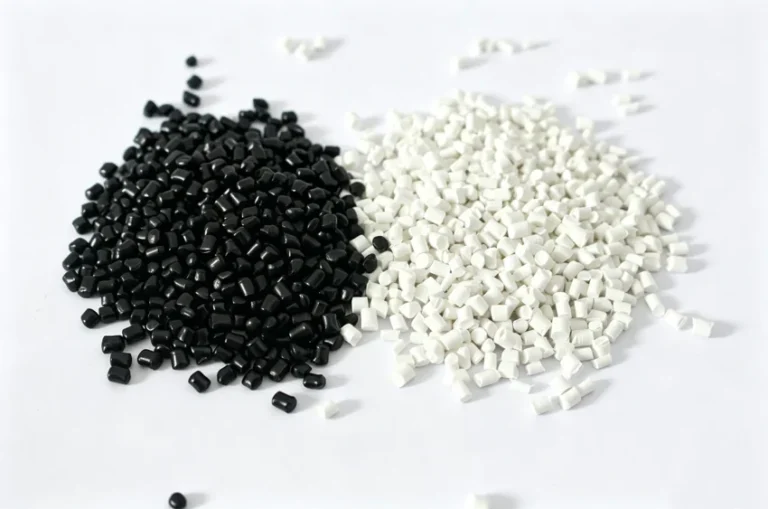
Read the black masterbatch concentration range without confusing it with dosing
The 18%–50% carbon black range published by MIRACLE refers to the concentrate family. It is not a statement that the customer should add 18%–50% concentrate to every film resin. The selected grade’s addition guidance and suitability must be reviewed against the intended polymer, process and appearance requirement.
An arithmetic illustration makes the distinction clear. A hypothetical concentrate containing 40% carbon black and used at 5% of the final mixture would contribute 2% carbon black by total mixture mass. A hypothetical 50% concentrate at a 4% final-mixture addition would also contribute 2%. These are calculations only, not MIRACLE grade specifications or recommended film dosages.
Equal calculated carbon black content does not prove equal appearance or processing behavior. The proposed concentrates can differ in formulation and the way they perform in the actual application. A buyer should therefore treat the calculation as one piece of the discussion, not as a replacement for evaluating the selected material in the intended film.
| Figure in a black-film discussion | What it describes | What it cannot establish alone |
|---|---|---|
| Carbon black content in the concentrate | The masterbatch composition being proposed | Final film appearance or the correct dosing level |
| Concentrate addition in the final mixture | How much selected material is introduced into the base resin | Dispersion quality, hiding or process suitability |
| Calculated carbon black in the mixture | A mass-balance result from known inputs | Equivalent performance between two different formulations |
| Approved finished-film sample | An observed result under its recorded preparation and viewing basis | Suitability after unreviewed changes to resin or film form |
Use the PE/PP family description as a starting point for the actual film resin
MIRACLE’s black offering sits within its PE/PP masterbatch portfolio. A film buyer should still identify the actual resin and manufacturing method. The family description is useful for locating the relevant supplier discussion; it is not a complete processing instruction for every resin that can be placed under the PE or PP label.
If the converter wants to use the same black concentrate for film and another plastic product, explain both applications. A thick molded article and a thin film do not necessarily expose the same visual priorities. The material should be evaluated for the proposed use rather than assumed to have acquired a second approval because the pellets are already held in stock.
For the wider sourcing picture, MIRACLE’s custom color family and white masterbatch family provide neighboring appearance routes. Their relevance depends on the customer’s finished design. They should not be presented as automatic substitutes for an unresolved black-film requirement.
Keep a black-film requirement separate from a UV or antistatic claim
A film’s dark appearance is not a complete functional specification. If the finished product requires a defined outdoor, antistatic or other function, identify that requirement explicitly. MIRACLE’s functional masterbatch range lists categories including UV, anti-aging, PPA, antistatic and antiblocking, providing a relevant starting point for a more specific conversation.
Do not infer a service life, electrical behavior or regulatory approval simply from the use of black concentrate. The selected formulation, application and required evaluation remain important. If a combined color-and-function route is proposed, establish what the proposal actually covers rather than assume every category in the wider portfolio has been incorporated.
Cabot’s black-masterbatch overview illustrates the importance of formulation and dispersion for intended plastic applications. That industry context does not transfer Cabot’s grades, performance claims or application approvals to MIRACLE’s material offering.

Make the film trial useful to the manufacturer’s development team
MIRACLE’s company information describes pilot-scale processing and sample evaluation. For a black-film enquiry, prepare the information that makes this development resource relevant: the intended film, actual resin, proposed material identity, addition basis and the appearance question that the trial needs to resolve.
If two trial samples differ, identify whether the difference concerns tone, hiding, visible uniformity or another observation. Record changes in film form and process alongside that feedback. A useful explanation gives the manufacturer a defined question to investigate instead of asking for an unspecified “better black” whose acceptance basis remains unknown.
The company also describes incoming-material attention and checks during manufacturing. Once a direction is accepted, retain the selected concentrate reference in the order so the material discussion continues to refer to the same product. The published family concentration range should not become a substitute for that more specific order identity.
Compare black-film offers by an accepted production result
A lower concentrate price is not enough to compare two proposals if the accepted addition levels or film results differ. For MIRACLE’s black family, obtain the selected material proposal and evaluate it against the intended film before turning the quote into a cost comparison. The published 18%–50% carbon black range does not supply the missing application result.
For the material cost of a simple resin-and-concentrate mixture, keep both components in the calculation. If an accepted mixture contains a fraction d of concentrate, its corresponding material-cost expression is (1−d) multiplied by the resin price plus d multiplied by the concentrate price. This is ordinary purchasing arithmetic, not a MIRACLE quotation, formulation or prediction of the converter’s total production cost.
As an illustration of the calculation’s structure, a mixture containing 4% concentrate would use 0.96 times the resin price plus 0.04 times the concentrate price. A different accepted mixture at 6% would use 0.94 and 0.06 respectively. Those addition figures are hypothetical. A buyer must not choose one as a recommended film dose or assume the two mixtures would produce equivalent hiding.
The accepted film remains the boundary of the comparison. If one proposal does not meet the agreed black appearance at the intended gauge, its attractive arithmetic is not an equivalent supply option for that job. If both do meet the relevant requirements, purchasing has a clearer basis for comparing the actual quotations and the order conditions associated with each material.
This gives a supplier discussion a more useful commercial focus. Instead of asking MIRACLE for the cheapest black percentage, describe the film that must be made, the evaluation that defines acceptance and the quantity to be supplied. The conversation can then connect the proposed concentrate with the buyer’s real production decision, while keeping unconfirmed dosage and performance assumptions out of the price comparison.
Stock black film concentrate by its approved use, not only by color
A distributor serving film converters should distinguish materials by their selected reference and agreed application. If two black concentrates have different approval histories, a broad stockroom label saying “black masterbatch” may not carry enough information to prevent confusion. Preserve the material identity that the converter actually evaluated.
MIRACLE’s configurable packaging discussion includes bag format, pack size, labeling and pallets. Use that flexibility to agree how the material will be recognized when it arrives and when it is issued to production. The actual arrangement should be confirmed for the order rather than assumed from a product or warehouse photograph.
For a closer look at manufacturing observations, the article on black masterbatch dispersion decisions separates several causes that a buyer should not treat as identical. The discussion of PE black concentrate for film versus thicker parts develops the application comparison further.
MIRACLE’s black family, related functional options and in-house development give film buyers a practical manufacturing relationship to work with. The strongest purchase is the selected material that produces an accepted film under a defined evaluation basis, not merely the bag carrying the largest concentration number or the darkest-looking pellets on the table.