
Blog
Choosing a TPE Compound Supplier for Grips and Compressed Components


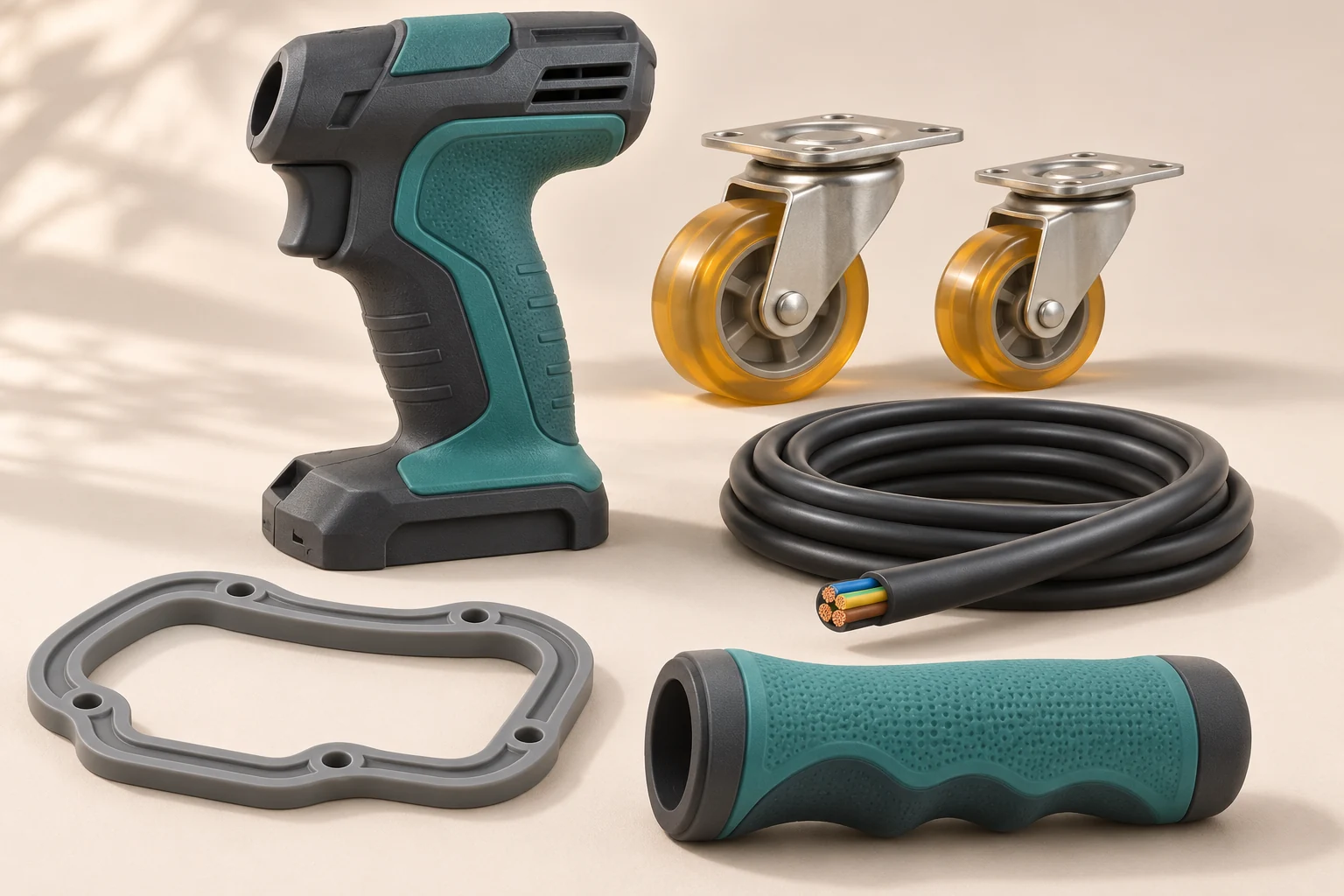
A hand grip and a flexible pad held between two parts may both be described as soft. Their working conditions are not the same. One is judged during contact and handling; the other may need to retain useful behavior while held in a compressed construction. A TPE compound supplier should understand that difference before a buyer asks one material to cover both. MIRACLE’s TPE, TPV, SBS-based TPE and TPU routes provide starting points for flexible-component discussions, supported by manufacturing and in-house development. Begin with each component’s actual job, not a shared softness label.
These two parts are hypothetical examples of different flexible-material requests, not claims of an approved MIRACLE pad or grip grade. They illustrate a practical sourcing advantage: a broader material conversation can help a buyer compare the requirements honestly while keeping the proposed compounds and their evidence distinct.
A TPE compound supplier needs to know whether the load is temporary or sustained
Describe what happens to the component after it is fitted. Is it touched and squeezed during use, held in a deflected state, compressed between mating parts or subjected to another defined operation? That working state can change the property questions behind the purchase. MIRACLE’s application brief asks how the part should feel, perform and be manufactured, so the load description belongs with the initial request.
For the grip, the buyer may prioritize the contact experience and the component’s fit in the actual product. For the compressed pad, the buyer may need to know what happens after the material has been held in the intended assembly. Giving both projects the same hardness target does not make their acceptance requirements equivalent.
For the pad brief, describe the mating construction and how the deformation is imposed. A fixed assembly gap and a part subjected to an applied load are not identical descriptions of the job. The relevant drawing or specimen arrangement helps MIRACLE understand what the buyer means by compressed. It also helps the customer’s engineer decide which material information or component assessment is needed before considering a common compound.
The grip’s contact requirement is not the pad’s recovery requirement
A grip sample can be useful for discussing touch and the intended handling operation. A compressed pad asks a different question about its behavior in and after a constrained state. Identify that difference before treating a positive hand-feel review as a reason to approve the pad material.
Suppose a purchasing team wants to reduce the number of flexible materials in a product program. It may reasonably ask MIRACLE whether a common candidate can be evaluated. The answer should come from the two application requirements, not from the convenience of buying one bag description. If the candidate cannot meet both, preserving two material decisions is more useful than forcing a commercial simplification.
Our grip material discussion develops the initial contact and part-feel questions. For the compressed component, add the actual deformation, time and environment information relevant to its job. Those details advance the discussion beyond another review of whether a loose sample feels pleasantly soft.
Compare TPE compound requirements by working state rather than by one hardness number
The following contrast helps a buyer explain the two requests. It does not assign a MIRACLE grade or prescribe a test. The responsible technical team should define the required properties and assessments for the actual component.
| Decision to describe | Hand-contact grip | Pad held in a compressed construction |
|---|---|---|
| State during use | Actual user contact and relevant handling operation | Defined compression or constraint within the assembly |
| Useful material question | Whether the selected material supports the required contact and function | Whether its response and retained deformation suit the stated condition |
| Representative evaluation | The relevant grip section and supported construction | The relevant specimen or component under agreed conditions |
| What softness does not establish | Every fit, contact or durability requirement | Recovery, retained function or qualification for a sealing job |
Compression set needs conditions, not an isolated percentage
Compression set concerns the deformation remaining after a specified compression and recovery assessment. The specimen, time, temperature and method are part of the result. Teknor Apex’s TPE selection discussion identifies loading and temperature conditions as relevant to a compression-set requirement. This is general selection context, not evidence that a MIRACLE material has completed a particular test.
If the customer’s drawing contains a compression-related limit, send the complete requirement rather than just a percentage. Confirm which information is available for the proposed compound and how any additional assessment will be arranged. MIRACLE’s published hardness and tensile equipment should not be treated as proof of a separate compression-test capability or result.
A value obtained for another material under another condition is not the pad’s approval. Even when two reports use similar property names, the buyer needs to understand whether their specimens and conditions support a meaningful comparison. A procurement spreadsheet should preserve that context instead of turning every mechanical property into a single unqualified score.
Creep is another term the buyer may encounter, but it is not a synonym for compression set. Avient’s property explanation distinguishes deformation under constant stress from the remaining deformation assessed after a specified compression. For the MIRACLE discussion, identify the actual property required by the pad specification. Do not accept a result for a different property merely because both reports concern a soft material under load.
A component’s stiffness during use is different from what remains after release
The force-related response while the part is being deformed and its state after the constraint is removed concern different aspects of behavior. State which matters to the application. A buyer should not use a pleasing first squeeze to describe the entire response of a pad that remains compressed in an assembly.
If the pad’s job requires continued contact with a mating surface, explain that function as well as any recovery requirement. A satisfactory shape after release would not, on its own, describe what happened while the pad was constrained. The technical parties should decide what assessment represents that working period. This keeps the purchasing decision attached to the component’s job instead of selecting whichever material property is easiest to obtain.
For example, a product team may find the pad easy to fit initially but still need to assess the condition after its specified use. Record those as two decisions. The first observation can remain useful without being stretched into evidence of the second. This gives MIRACLE’s development conversation a more precise target. Identify the feature that must remain useful after that assessment, so a general comment about recovery does not conceal the actual component acceptance requirement.
Discuss MIRACLE’s flexible-material routes without declaring a universal winner
Our portfolio lists TPE, TPV, SBS-based TPE and TPU. The broad TPE term and the more specific material-route names do not identify interchangeable compounds. A buyer can bring an existing family requirement or an open component problem, but the selected material still needs an identifiable application basis.
A TPV or TPU name on the drawing still needs the component requirement
If the pad specification already calls for TPV, provide that requirement and the reason it was selected. If another component calls for TPU, identify that separately. MIRACLE can discuss those listed routes, but the family name alone does not supply compression, wear, chemical or temperature performance for the proposed grade.
Do not declare TPV the pad winner or TPU the grip winner from a general comparison chart. Such charts can help explain material families, but the buyer’s decision concerns a particular compound and construction. Ask what selected-material information is available and which application questions remain to be evaluated.
An SBS-based TPE request should likewise retain the specified material basis and actual use conditions. It should not be substituted for an unidentified old compound simply because the initial samples feel similar. The useful comparison preserves the working requirements of the grip and pad rather than replace them with broad family stereotypes.
Prepare two component evaluations that can support a common supply decision
Our development and evaluation approach considers the part design, desired feel, hardness target, process and relevant mechanical questions. For this two-component program, use that approach to identify what the proposed material must demonstrate in each part. The buyer can then decide whether consolidation is technically justified.
First, keep the component geometries recognizable. A grip-shaped trial and a pad specimen do not need to look the same to be useful; they need to represent the question being asked of them. If one is only a screening specimen, identify that status before calling the entire product program accepted.
Second, preserve the material identity through each preparation. If the converter uses different candidates for the grip and pad, make the difference explicit. If it is deliberately comparing one compound in both, record that intention so the result can be understood without assuming a material substitution.
Define what the common-material proposal is meant to simplify. A distributor may want one inventory item; a converter may want a more convenient production program. Those are legitimate commercial objectives, but neither changes the grip or pad acceptance requirement. MIRACLE can discuss the material routes around both briefs, while the buyer judges whether the proposed consolidation preserves the necessary behavior of each component.
Retain the grip approval while the compressed pad question remains open
Suppose a candidate meets the grip’s contact and fit requirement but has not yet completed the pad assessment. The useful status is not a blanket pass or fail. The grip decision can progress while the compressed-component requirement remains open. MIRACLE’s development team can discuss the unresolved question without discarding an accepted part of the project.
The manufacturer’s component development route explains how preparation and material evaluation support an identifiable decision. In this program, the additional discipline is to keep two application outcomes separate until the buyer has evidence for any common-material release.

Keep the grip and compressed-component roles visible in the material order
MIRACLE’s manufacturing checks include incoming inspection, initial production review, interval sampling and self and peer cross-checks. For the two-component project, connect the selected material descriptions to their actual accepted uses. A common manufacturing route is helpful; it does not replace the separate component evidence.
If the program retains two compounds, agree how the grip material and pad material will be distinguished for the processor. MIRACLE coordinates packing and shipping for the actual order, with quantities and arrangements confirmed. Receiving should not consolidate the materials by pellet appearance after engineering deliberately kept their requirements separate.
If one compound is accepted for both parts, record that application scope rather than broaden it to every flexible item in the buyer’s catalogue. A third component with another loading condition is a new question. The benefit of a direct manufacturer discussion is that it can be reviewed, not that the first consolidation becomes unlimited permission to substitute.
For a sealing, contact-sensitive or other qualified application, identify the separate requirement before release. This article’s hypothetical compressed pad is not evidence of a sealing grade, service life or regulated approval. Confirm the applicable material documents and application assessment for the actual use.
Buy the common compound only when it answers both component questions. Otherwise, keep the grip’s contact requirement and the pad’s sustained-deformation requirement attached to distinct materials. MIRACLE’s flexible portfolio can support that discussion without forcing two different working states into one softness description.