
How a Color Masterbatch Manufacturer Turns a Reference into a Working Formulation

A physical sample says what a customer likes; it does not automatically describe how that appearance should be produced in another resin. A color masterbatch manufacturer has to translate the reference into a material discussion that includes the base polymer, processing route and final article. MIRACLE’s customizable PE/PP colors, dedicated PET carrier family and in-house development give product teams a practical place to begin that translation.
The strongest starting package is a reference that can be identified, a description of the actual product and enough process information to make sample evaluation relevant. MIRACLE’s pilot-scale development capability supports this approach. It connects the visual intention with material preparation rather than leaving purchasing to choose a concentrate by pellet color alone.
For buyers who want a direct manufacturing relationship, the benefit is continuity between the color conversation and the material behind it. The objective is not to copy an unknown recipe or promise a match under every condition. It is to develop a proposed route that can be judged against the product the customer intends to manufacture.
Give the color masterbatch manufacturer a reference with a clear job
A reference may be an existing molded part, a fabric swatch, a color code or another agreed visual standard. These do not all carry the same information. A physical article can show surface and thickness as well as color; a code may communicate a color direction without reproducing the final material’s appearance. Explain what the reference represents before asking the material team to interpret it.
Imagine a product developer bringing a smooth display sample for a new PP household item whose production surface will be textured. This is an illustrative development situation, not a MIRACLE project history. The developer should state whether the intention is to reproduce the sample’s color impression on the textured article, preserve a measured color under defined conditions or achieve another agreed appearance objective.
Those distinctions are useful rather than overly academic. If the team later compares a smooth sample and a textured part without acknowledging the different surfaces, a formulation adjustment may be requested for the wrong reason. A direct manufacturer conversation can help establish which sample and which surface will actually govern approval.
MIRACLE’s custom color masterbatch range is presented around the target shade, finished appearance and resin-processing requirements. Use those three elements together. Sending the product context early gives the development work a clearer destination than a request for a color that is simply described as stronger, brighter or more premium.
A PE/PP color reference should identify the production polymer
The same visual direction can lead to different discussions in PE and PP. Identify the actual resin used by the converter, the intended processing method and the sample form that will be evaluated. “Suitable for plastics” is too broad to act as an engineering description when the buyer expects a particular article to emerge from a particular line.
Where the resin has already been selected, retain its identity through the sampling exchange. Where it is still being chosen, make that uncertainty explicit. The manufacturer can then understand whether the sample is intended to evaluate a fixed production system or to help compare possible material directions. These are different development questions and should not be hidden inside one color request.
PET color development starts with the polyester route
MIRACLE’s PET carrier masterbatch provides a dedicated basis for relevant polyester enquiries. Describe the desired glossy appearance and whether transparency or opacity is important. Do not assume that an approved PE/PP concentrate can be carried into PET merely because the target shade is unchanged.
For a PET article, the proposed material should be discussed with its actual process and finished form. A clear-colored design and an opaque design can require different appearance evaluations even within the same broad product family. The manufacturer’s role is to connect that intention with a relevant proposal, not to treat all red or blue pellets as the same route.

Turn a color reference into a comparison the factory can repeat
A sample only becomes useful for approval when its comparison basis is clear. Record which base resin was used, the proposed concentrate reference and the conditions relevant to sample preparation. For a molded article, retain the geometry and surface that will be assessed. For film, keep the thickness and intended visual background visible in the discussion.
MIRACLE’s company information describes pilot-scale equipment used to reproduce key production conditions and evaluate sample suitability. This is an important development resource because the proposed material can be considered in a processing context. It is not a claim that pilot equipment exactly reproduces every customer machine or that a trial on the converter’s own line is unnecessary.
The buyer’s contribution is a useful account of the real job. A film producer who wants a translucent color should say so before evaluating a sample intended to hide the background. A molded-parts team should identify a textured face rather than approve only a smooth plaque and hope the production surface will appear identical.
For broader industry context, Avient’s description of color-design services links design intention, color translation and sampling. The general lesson is that formulation work connects a visual idea with a manufacturable material; another supplier’s service claims or turnaround times do not define MIRACLE’s proposal.
A color trial should answer one defined appearance question
Do not change several interpretation points at once and expect the feedback to be easy to explain. If the new sample uses a different resin, a different thickness and a different viewing basis, identify those changes. A better development exchange can then distinguish what the color proposal is showing from what has changed around it.
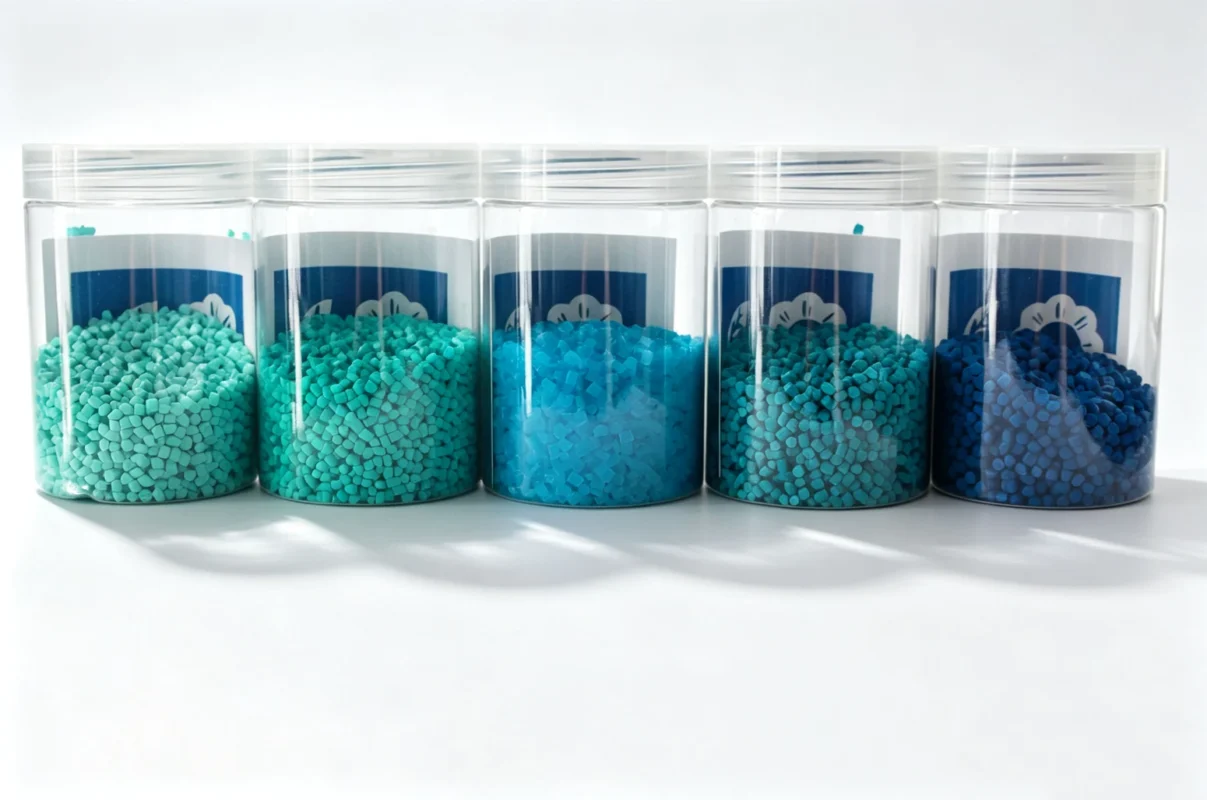
This is particularly useful for a manufacturer introducing several related shades. The team may share an overall design direction while each shade still needs a recognizable sample and material reference. Keep the approved article associated with the corresponding concentrate instead of treating a collection of similar sample jars as the complete record.
State the PE/PP color addition basis without ambiguity
An addition figure should say what its denominator means. As an arithmetic illustration only, adding 2 kg of concentrate to 100 kg of base resin produces 102 kg of mixture: the concentrate is approximately 1.96% of that total. A mixture described as 2% concentrate by total mass would instead contain 2 kg of concentrate and 98 kg of base resin. These figures are not MIRACLE dosage recommendations; they show why two apparently similar trial notes may describe different mixtures.
For a PE or PP color development exchange, write the actual trial quantities and the convention used by the dosing system. This lets the parties interpret the observed shade against a defined preparation basis. The formulation discussion can then address the intended result rather than inherit an unnoticed difference between “percent of resin” and “percent of total mixture.” The selected material’s application guidance still needs to be confirmed for the proposed grade and process.
Know when black, white or functional masterbatch belongs in the formulation discussion
MIRACLE’s range includes separate black and white masterbatch alongside custom colors. Those families matter because the desired appearance may involve more than a hue. A buyer developing a darker molded product, a white package or a colored film with a hiding requirement should explain the finished objective rather than assume that color strength alone resolves it.
The black series is published with 18%–50% carbon black across different applications. The white series is published with 20%–80% TiO₂. These are concentrate-family ranges. They do not establish universal addition levels, guarantee the appearance at a particular thickness or make the highest percentage automatically the correct choice for the project.
The practical advantage of the white masterbatch options and neighboring black family is that neutral-tone and opacity questions can be recognized early. The final proposal should still identify the selected material and how the buyer will evaluate it in the intended article.
If a requirement includes a function beyond color, bring that into the brief before approval. MIRACLE’s functional masterbatch portfolio lists anti-aging, UV, PPA, antistatic and antiblocking categories. A listed function is a starting point for discussion, not proof that every color and carrier combination has already been confirmed.
Read trial feedback as evidence about the finished product
A useful review separates observations. Is the color direction acceptable but the film insufficiently opaque? Does the molded surface differ from the approved reference? Is a visible defect appearing alongside otherwise acceptable color? These descriptions lead to different questions, so avoid compressing all of them into a single statement that the color is wrong.
MIRACLE’s development and quality approach connects material selection with attention to the actual resin, process and final result. Retained samples and identified trial conditions make that exchange more concrete. They give both sides something to compare without inventing an explanation before the observation has been understood.
Suppose a packaging team changes its intended film thickness after an early shade review. The buyer should identify the new product condition and evaluate a relevant sample. Treating the old approval as an unconditional promise would make the manufacturer responsible for a requirement that was not represented in the original comparison.
Conversely, a defined trial is not merely paperwork that protects the supplier. It also helps the buyer preserve a successful direction. When the sample, resin and evaluation basis are retained, the accepted appearance can become a clearer reference for the order and later production discussions.
Bring production discipline into the custom-color order
MIRACLE describes incoming-material monitoring, control of processing conditions, initial examination and sampling during manufacture. Self-checks and cross-checks are part of its stated approach. These production practices support the company’s role as a manufacturer, rather than limiting the relationship to a sales description of colored pellets.
For the buyer, the approved color material should have a reference that survives the move from development to purchasing. The relevant current documents, expected quantity and packaging discussion should follow that identity. If a specific test or declaration is needed, confirm its scope for the selected grade and application instead of assuming it follows every custom color.
Packaging can be discussed around bag format, pack size, labeling and pallet arrangements. That flexibility is useful for factories handling several custom shades: clearly agreed material identification can help the stockroom distinguish concentrates that might otherwise be described by similar informal color names.
The order should repeat the actual approved requirement, not just a broad family description. If the application or resin changes before release, bring the change back into the development conversation. A direct relationship with the manufacturer is most useful when those technical and commercial discussions remain connected.
Keep ownership of the color decision clear
A successful custom-color program leaves the customer with a recognizable approval basis and the manufacturer with a defined material requirement. It does not require the buyer to possess the supplier’s confidential formulation, and it should not depend on an unidentified sample kept only in one person’s drawer.
Teams deciding what the finished article should control can compare the discussion of choosing a supplier around the finished part. Engineering teams approaching larger production runs can use the separate guide to masterbatch scale-up decisions without confusing formulation approval with a complete production release.
MIRACLE’s custom colors, carrier-based options and in-house development make a strong starting combination for that work. Bring a reference with a clear purpose, evaluate the proposed material in a relevant form and retain the decision that the sample actually supports. The most useful color formulation is the one your production team can connect back to the product it is expected to make.